Irises
Mid-May to mid-June, with a second flowering in autumn.
With over 400 varieties of iris, our collection is one of the most modern in Europe. Some even flower twice a year, prolonging the magic until autumn.
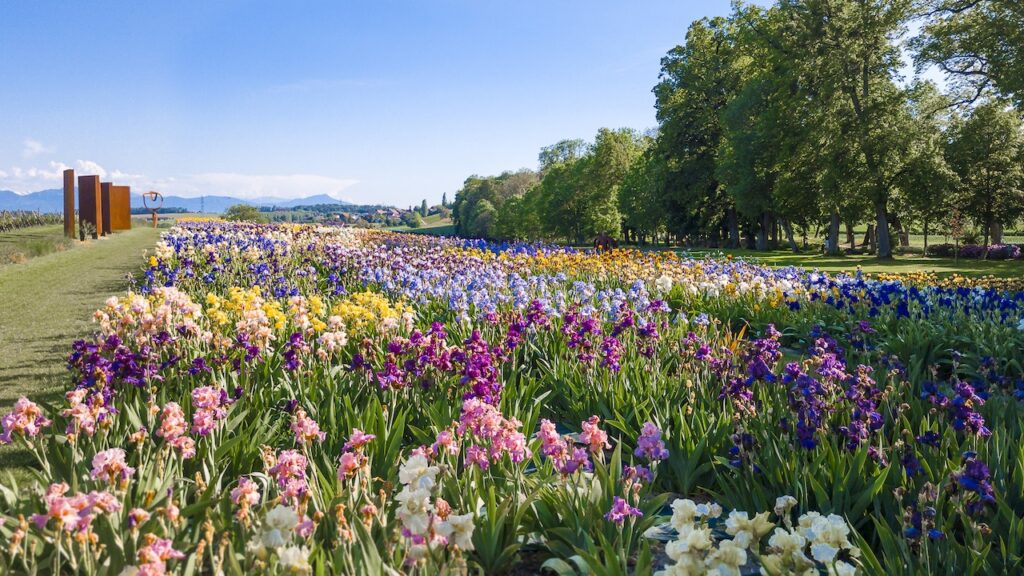
“The beauty of their colors and the unusual shape of their flowers inspired Van Gogh and Monet. Whether in old gardens or the most contemporary ones, they have their place. Once planted, they are hassle-free!”
Your criterion: height
The height of irises determines where they should be planted in your garden. Irises are divided into five groups:
Dwarf irises (Iris barbata-nana) for rock gardens: these grow to a maximum height of 30 cm. They are the first to flower in mid-April, heralding the arrival of spring! These dwarf irises can also be grown in pots for those who only have a balcony or window sill. For a beautiful effect, you will need between 12 and 15 irises per square meter.
Border irises (Iris barbata-nana) are used to highlight the design of flower beds or the curves of paths. Their flowers are very similar to those of tall irises, but their stems are much shorter, no more than 30 cm high. They bloom in early May.
Intermediate irises (Iris barbata-media), 40 to 70 cm tall depending on the variety: they are perfect in the middle of a flower bed, to brighten up a sunny slope, in windy locations, or for bouquets. For a spectacular flower bed, allow 10 to 12 irises per square meter.
The tall irises (Iris barbata-elatior), also known as garden irises, grow to between 70 cm and over a meter in height: these are the best known and have the largest flowers… spectacular irises for large spaces. They are the last to bloom, between mid-May and mid-June, and some varieties now also bloom in autumn; these are marked with an R in our list.
Siberian irises (Iris sibirica), which grow to around 80 cm tall, unlike the previous varieties, thrive in moist soil and can flourish on riverbanks. However, they also grow well in normal soil, provided it is not too dry in summer. They flower at the same time as tall irises, between mid-May and mid-June.
Irises are so popular that specialists have created and continue to create thousands of different varieties, with new ones appearing every year. In our gardens, we introduce around ten new varieties each year. The most recent ones are more floriferous and robust. The flowers are larger and longer-lasting, carried on sturdy stems that are slightly shorter—around 85 cm instead of the 90 cm of older varieties. They are less susceptible to lodging and keep the flowers clearly visible.
All the irises in our collection are available for purchase on site (via the order form) or in our online store.
Your criterion: color
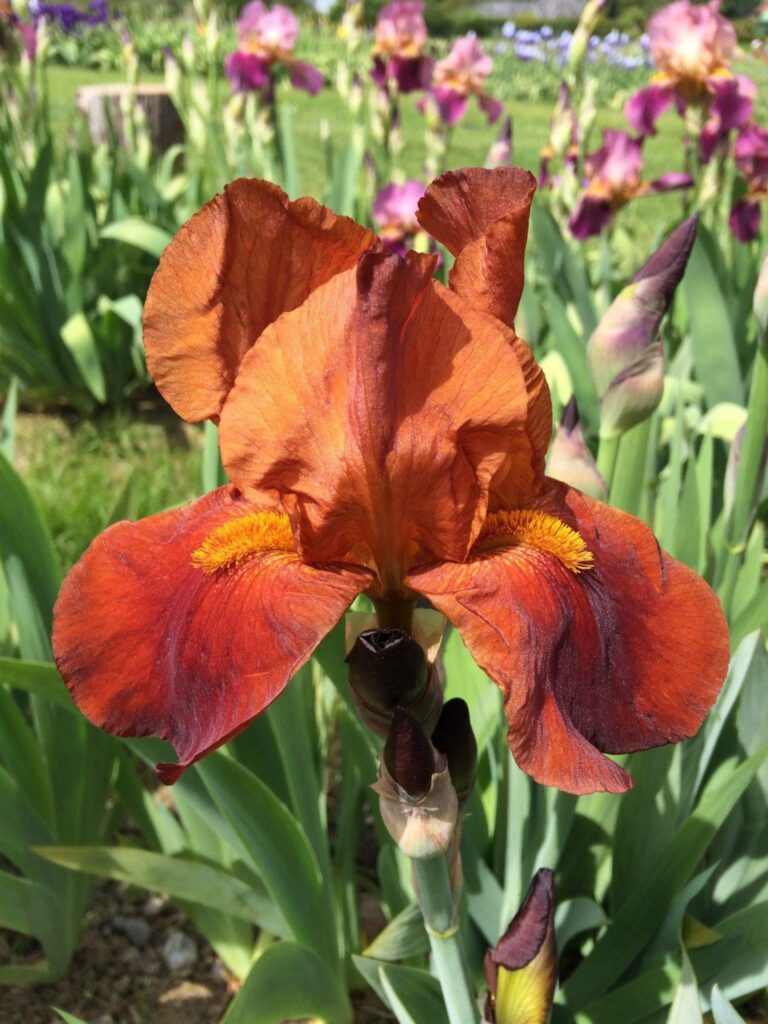
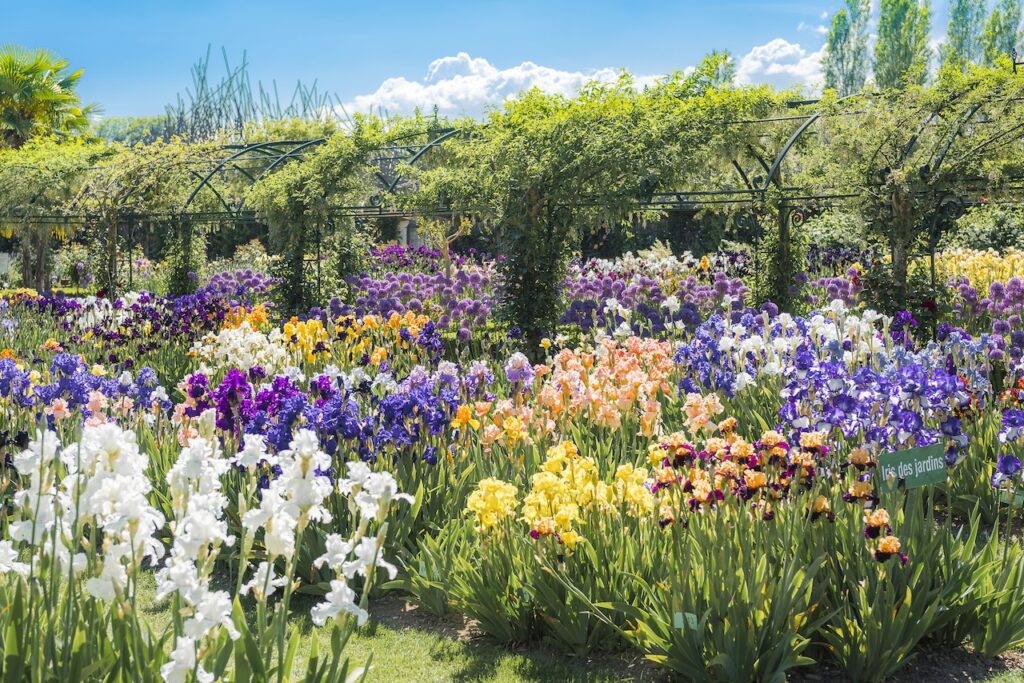
It is no coincidence that they bear the name of the messenger of the Olympian gods, whose multicolored scarf gives rise to rainbows. Irises come in almost every color imaginable, in a thousand different shades. Blue and purple are the traditional colors, but over the years the palette has been enriched with yellow, orange, black, red, brown, and more. Two-tone varieties are becoming increasingly common. The contrast between the two colors gives the flower greater depth. Warm tones—honey, rust, mahogany, purple—and subtle shades—salmon, peach, cream—are in fashion. The search for the perfect red continues, but some varieties, such as ‘Rustler’ and ‘Dynamite,’ are already coming close.
Your criteria: long flowering period and double blooms
Although iris blooms are breathtaking, each variety only lasts for about three weeks in spring, once the plant is well established. By combining different iris families in your garden, you can enjoy continuous blooms from mid-April to mid-June, for two whole months. That’s quite something… And that’s not all! In recent years, repeat-flowering iris varieties have been developed: they bloom like the others in spring and again in late summer, during the month of August, with a little care to encourage this second flowering. This is sure to delight lovers of long-lasting blooms!
When properly planted and separated every 2-3 years, irises can bloom in your garden for years.
Learn more about daylilies