Planting tips
Specialists in irises and daylilies for nearly 70 years.
Planting tips
Location
Choose a sunny spot, as irises need at least half a day of sun but prefer a full day of exposure. It is also important that the soil is well-drained. Plant irises on a slope or in a raised bed.





Depth
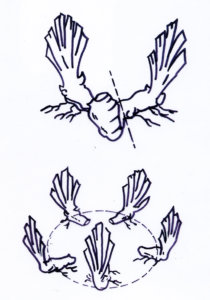
Plant irises so that the rhizomes are flush with the soil and the roots are spread out evenly around them and pointing downwards. Do not plant irises too deep.
Spacing
A space of 30 to 50 cm is generally left between each rhizome. Planting more closely together will give a greater effect in the first year, but will then need to be thinned out more frequently.
Watering
Water irises after planting to help the roots establish themselves. Once irises have taken root, they normally do not need to be watered, except in dry areas.
Fertilizer
The choice of fertilizer depends on the nature of the soil. In general, bone meal, superphosphate, and NPK 6-10-10 fertilizers are all effective. A light application of fertilizer in early spring and one month after flowering can be beneficial. Avoid fertilizers with a high nitrogen content, as these promote rot.

Planting tips
Planting period
Daylilies can be planted practically all year round except during the flowering period, but we only deliver them in September and October. Planted in early fall, they are more likely to flower the following summer.
Location
Choose a location that receives at least 4 to 5 hours of sunlight per day and well-drained soil. Avoid shade and marshy ground.
Soil preparation
Before planting, the soil must be deeply tilled. It is a good idea to incorporate organic fertilizer (well-decomposed manure) or a commercial product to achieve a slightly acidic pH of 6.0 to 7.0.
Depth and spacing
Dig a hole 20 to 25 cm deep. Add water. At the bottom, make a small mound of fine soil/compost on which to place the rhizome. Spread out the roots, ensuring that the plant’s collar is just below ground level. Fill the hole with soil and tamp down. Leave a space of 40 to 60 cm between plants.
Your questions about irises and daylilies
Flowers
Are some irises more resistant than others?
Yes. Darker colors (blue, purple, black) are more resistant than lighter colors, but it also depends on the variety.
Can irises change color?
No. If they change color, it means they have been planted too close together and the darker color is dominating the lighter color.
Do irises multiply?
Yes, they can multiply by dividing into three every two years.
Flowering
Do irises bloom in the first year?
Normally, yes. They may not bloom in the first year, but they will definitely bloom in the second year.
Why aren't the irises blooming?
If irises do not bloom or no longer bloom, it may be because they are too close together, so they need to be divided.
Planting
Once we receive our order, should we plant the irises immediately?
Yes. If this is not possible, you can leave them in the open box in a cool place for about 1 week.
Can irises be planted at all altitudes?
Yes, that’s not a problem, but it’s best to choose smaller irises because of the wind, to prevent them from falling over.
What kind of soil should be used for planting irises?
Irises like normal garden soil or vineyard soil, which must be well aerated.
What fertilizer should be used for irises?
Regular garden fertilizer.
How often should fertilizer be applied?
Once before flowering and once after flowering.
Is it possible to grow irises in pots?
It is not recommended because they really need their space, but it is possible if the pot is large.
Maintenance
Do irises need sunlight?
Yes, they love it. They need at least half a day of sunshine every day, but if they get more, that’s even better.
Should irises be watered?
Yes, when you plant them. Then, if it is very dry, otherwise it is not necessary, as they do not like humidity.
When should irises be divided?
They should be divided after flowering, i.e. from late July to early October.
What should you do with irises in winter?
Only cut the leaves before fall. The rhizomes remain in the ground during winter.
Should the leaves and stems of irises be cut?
Cut back the stems after flowering to prevent them from rotting, and cut back the leaves in early fall (to about 4 to 6 inches).
Why do irises rot?
This may be because they are exposed to too much moisture. It is therefore important to remove weeds so that they are well aerated.
Delivery
What is the delivery time?
When placing your order, you can select the month in which you would like your order to be delivered (August, September, or October, which are the planting months).
What is the shipping cost?
We charge between CHF 10 and CHF 15 for shipping within Switzerland and other European countries. CHF 10 for orders of less than 10 items and CHF 15 for orders of more than 10 items. Shipping is free for purchases over CHF 150.
Can you ship internationally?
Yes, only in Europe.