
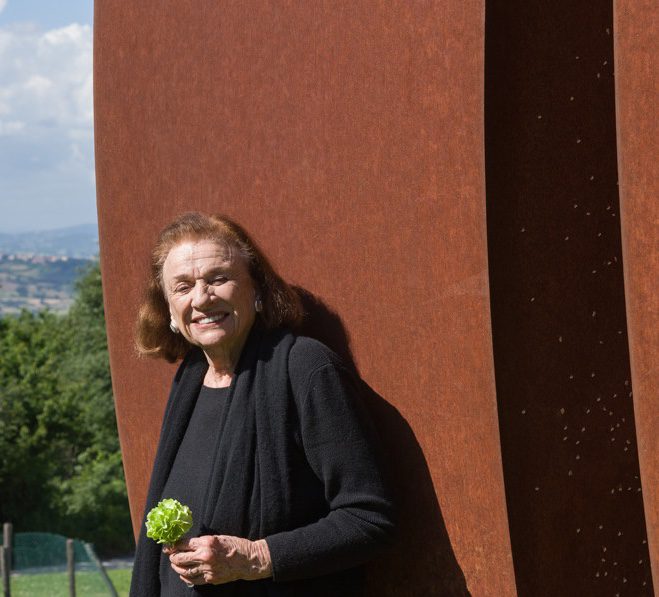
Pepper trained in painting under Fernand Léger and André Lhote in Paris, then studied advertising design, photography, and industrial design at the Art Students League of Brooklyn and, in 1940, at the Académie de la Grande Chaumière. During her time in Italy, she met journalist Curtis Bill Pepper, her future husband, and exhibited for the first time in 1952 at the Galleria dello Zodiaco in Rome, presented by Carlo Levi. Influenced by the Forma group, she associated with Achille Perilli, Pietro Consagra, Piero Dorazio, and Giulio Turcato. After a trip to Angkor Wat in 1960, she turned to sculpture, creating small forms in wood and clay, and then experimented with connective art and environmental projects between 1967 and 1969. Between 1971 and 1975, she completed her first major environmental project in Dallas: Dallas Land Canal and Hillside.
Pepper exhibited for the first time as a sculptor in 1961 in New York and Rome at the Galleria Pogliani, presented by Giulio Carlo Argan, and then participated in the 1962 Sculture nella Città festival in Spoleto. She subsequently created medium and large-scale works in the Italsider workshops in Piombino, confirming her transition to metal. In 1971, Rome hosted a dozen of her stainless steel sculptures in the Piazza Margana, before her participation in the 34th Venice Biennale in 1972. Her Land Art projects include Amphisculpture in New Jersey (1974-1976), Documenta 6 in Kassel (1977), and numerous public installations such as the Todi Columns, Spazio Teatro Celle, Manhattan Sentinels in New York, and Broken Circle in Umbria. In 2014, she exhibited her Curvae series at the Ara Pacis Museum in Rome.
Among her accolades are the Allied Arts Award of Honor from the American Institute of Architects (1999), the Alexander Calder Award, the Xavier College Preparatory Vision and Voice Award (1999), the Pratt Institute Legends Award (2003), the Pratt Alumni Award (2007), and the International Sculpture Center, USA Lifetime Achievement Award (2013).
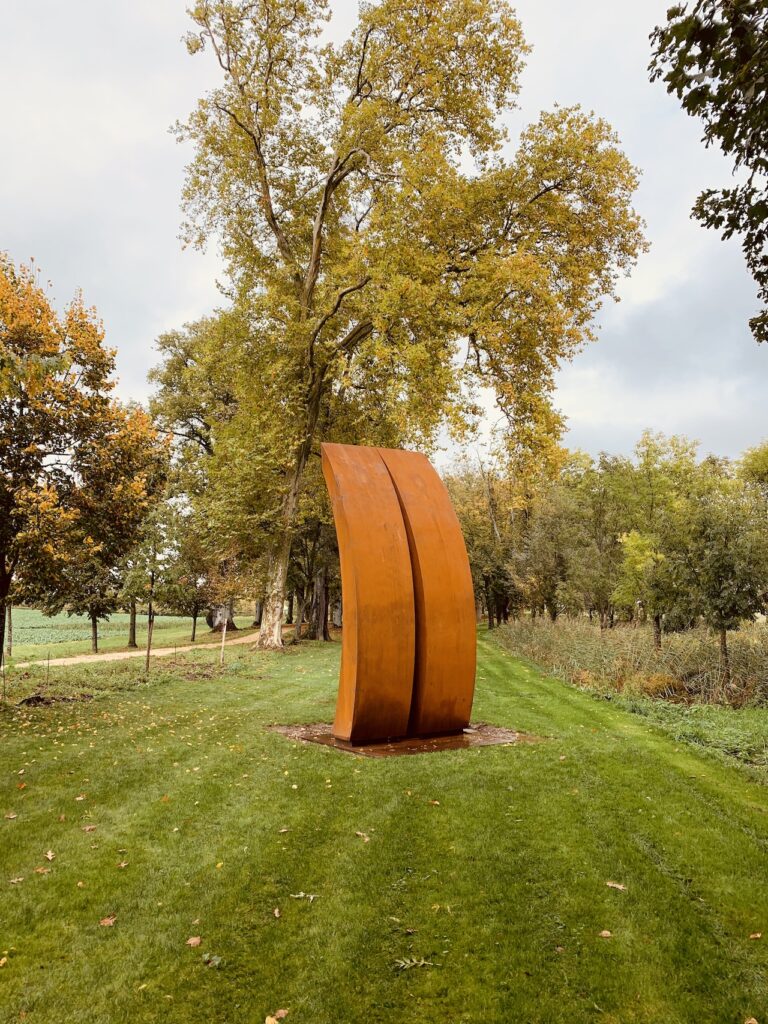
Since 1964, Beverly Pepper has worked primarily with Cor-Ten steel, exploring its natural transformations to create unique sculptures. Her interest in industrial materials and natural landscapes evokes both Minimalism and Land Art, though she has never been associated with either movement. Her work has been exhibited in New York and at the Venice Biennale, and her archives are held at the Frederik Meijer Gardens & Sculpture Park.