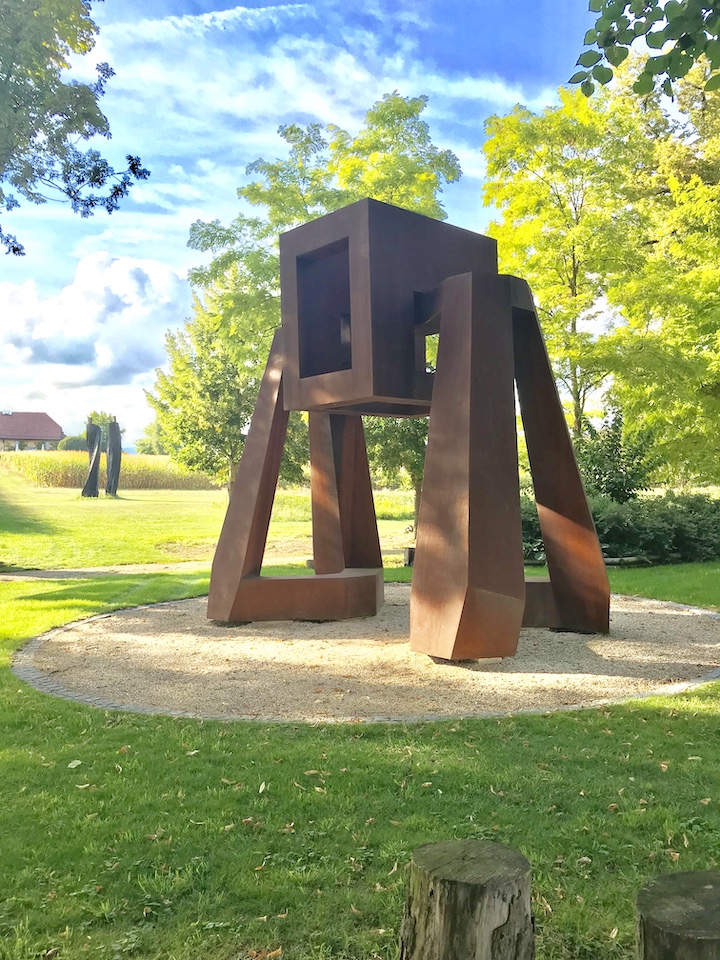
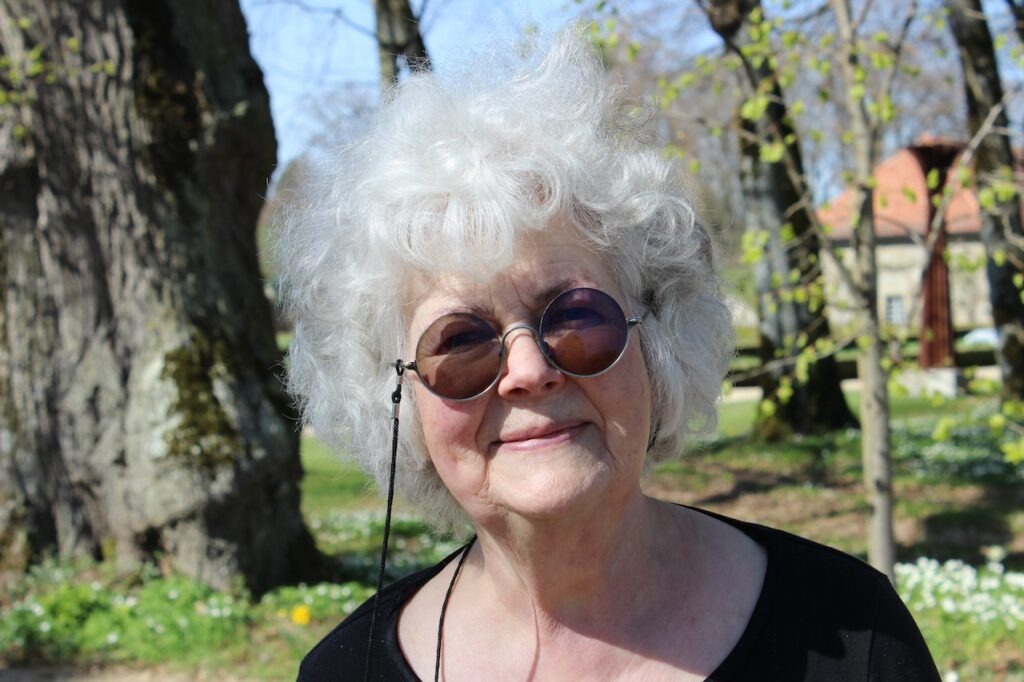
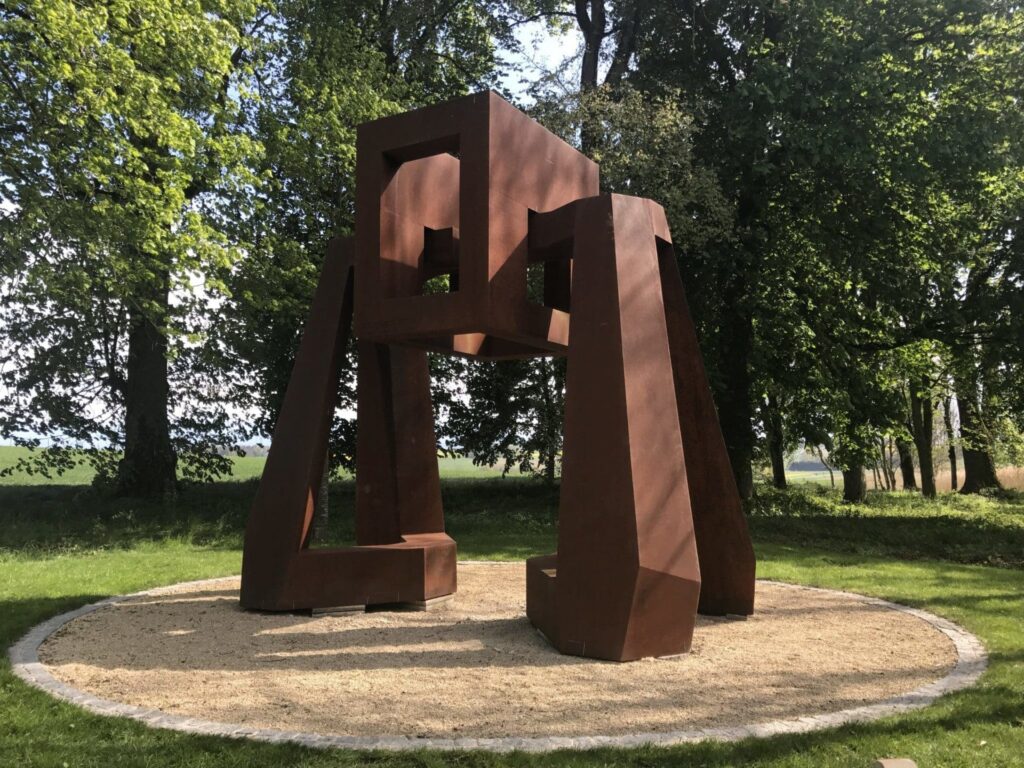
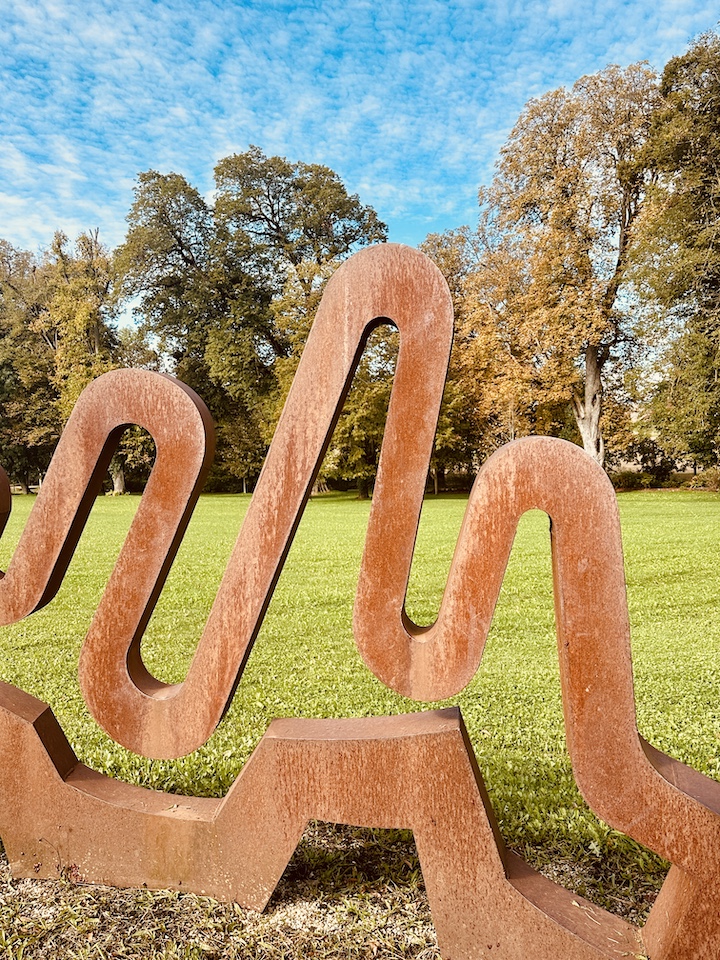
Gillian White had to give up dancing at the age of 15 for health reasons and then dedicated herself entirely to art. She studied at Saint Martin’s School of Art and the Central School of Art and Design in London, and then at the École nationale supérieure des beaux-arts in Paris. In 1966, she moved to Switzerland with her future husband, the artist Albert Siegenthaler, to a studio they built themselves. Since 1972, she has lived and worked in Leibstadt, in the canton of Aargau, where she creates monumental pieces, primarily in Corten steel. Her work is distinguished by the rigor, symmetry, and rhythm of its lines, giving rise to poetic, light, and harmonious works, often choreographed as if in motion.
Gillian White won her first competition in 1969 with Gewässerschutzplastik, a polyester sculpture for a public art project in Olten. Her works are exhibited in numerous public and private spaces, including: the EPFL campus in Lausanne, the Kulturweg Baden-Wettingen-Neuenhof, the Black Forest, Winterthur, and the Villa Berberich in Bad Säckingen. In 2009, the Kunstmuseum Olten organized a retrospective of her work, highlighting the importance and recognition of her work both in Switzerland and internationally.
Gillian White’s art is distinguished by its rigor, visible in the symmetry of its lines, the precision of its rhythms, and the balance of its static structures, which, paradoxically, give rise to poetic, light, and harmonious works. Her sculptures often express forms in motion, as if the artist had choreographed them to dance to the rhythm of nature, in her own words.