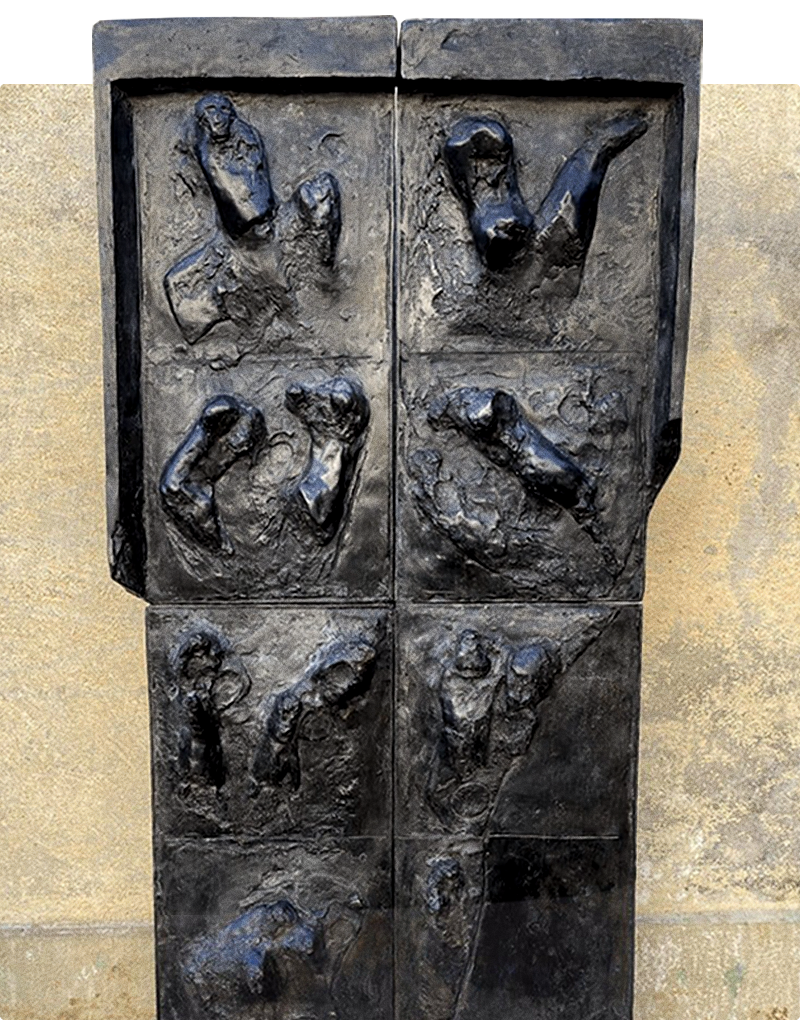
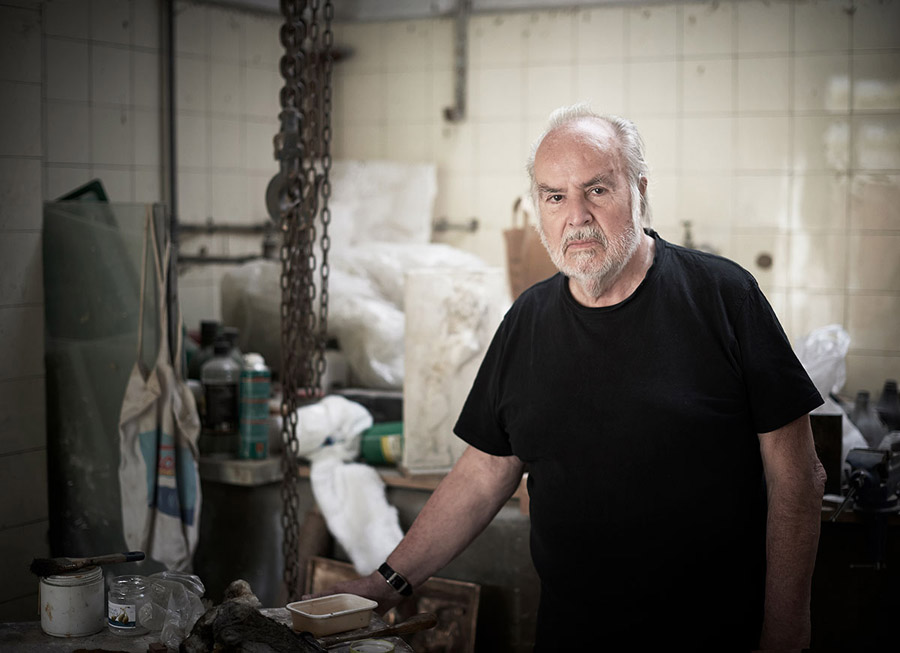

Marcel Mathys, a Swiss artist originally from Le Locle in the canton of Neuchâtel, spent his childhood in that town. From 1949 to 1953, he trained in engraving at the School of Art in La Chaux-de-Fonds, while also attending painting classes with Georges Dessouslavy and learning modeling from Léon Perrin. Between 1954 and 1957, he worked as an engraver for Huguenin Frères, medal makers in Le Locle, before becoming self-employed. He then undertook various works related to medal making, including the engraving of dies, as well as chiseling bronzes intended to adorn clocks. From 1959 onwards, he turned to sculpture, initially in plaster and cement, then, two years later, in stone—primarily marble—and finally in bronze. His artistic commitment led him, in 1972, to join the Salon des Réalités Nouvelles in Paris, where he exhibited regularly for twenty-five years. In 1987, the Museum of Art and History of Neuchâtel dedicated a retrospective exhibition to him, and the following year he received the prize from the Neuchâtel Institute.
Alongside his sculpture practice, Marcel Mathys also devoted himself to engraving, drawing, and lithography. He illustrated numerous authors, including Pierre Chappuis, Jacques Chessex, Vera Feyder, Jayadeva (translated from Sanskrit by D. Wohlschlag), Monique Laederach, Florian Rodari, and Sappho (translated from ancient Greek by P.-A. Aellig), and regularly contributed to the Revue de Belles-Lettres. His engravings are held in several museums and libraries: the Musée du Locle, the La Chaux-de-Fonds Library, institutions in Neuchâtel, Dorigny and Lausanne, the Cuendet Foundation and the Saint-Prex Workshop, the Vevey Print Collection, the university libraries of Boston and Yale, the National Library of Washington, the New York Public Library, and the National Library of Paris. His complete engraved works are preserved in the Mathys Collection at the National Library of Bern.
Marcel Mathys’s works, often imposing in scale, transform the space in which they are placed. Through his sculptures, he seeks to challenge our perception of the environment and to encourage the viewer to reconsider their visual frame of reference. Mathys’s creations are often geometric, a formal abstraction that plays with angles and perspectives, transforming the surrounding space and the way we perceive it.