History of the estate
A family heritage unique in Switzerland.
A historical heritage dating back to the 13th century
A 13th-century medieval castle
The first mention of a parish in Willerens dates back to 1228, when its land belonged to the barony of Cossonay. In 1308, Pierre de Duin obtained permission from the Lady of Cossonay to build a fortified house with a village and became the first lord of the area. It was an imposing feudal fortress with two enclosures, one of which was partially crenellated and dominated by an enormous square tower with machicolations. Thanks to a land registry from 1685, we know that the medieval castle was surrounded by a double crenellated wall and had a garden and an orchard. According to this old plan, the building had three-story main buildings connected by half a dozen towers, one of which was particularly imposing.
Guillaume de Colombier became the owner following his marriage to Guillermette de Duin, and their descendants owned the land until the family died out in the 16th century.
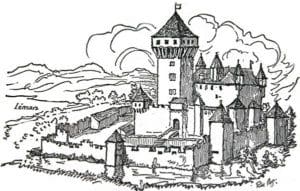
In 1421, Vullierens became a banneret seigneury, dependent on the bailiwick of Vaud, and passed to Henri de Colombier, Lord of Vufflens. Through the vicissitudes of marriage and inheritance, Vullierens was successively owned by the Colombier family, then the Allinges family until 1665, when a sovereign ruling awarded Vullierens to the nobleman Henri de Mestral. Having no descendants, Henri de Mestral bequeathed the seigneury to his nephew Gabriel-Henri de Mestral (1670-1753). It was the latter who undertook the demolition of the medieval castle and the reconstruction of a new residence between 1706 and 1712. Since then, the castle has remained in the hands of the de Mestral family and their direct descendants, the Bovet family.
A 17th-century French-style castle
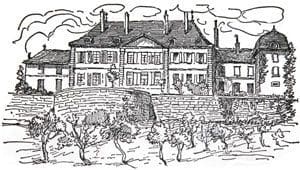
When Gabriel-Henri de Mestral inherited the estate, the medieval castle was in poor condition. He decided to demolish it and rebuild on its ruins a residence in keeping with the tastes of his era, with numerous outbuildings including an orangery.
At the end of the 17th century, the construction of a “little Versailles” in L’Isle caused quite a stir in the region. In 1694, Charles de Chandieu (1658-1728), an officer in the French army, and his wife Catherine Gaudicher d’Aversé (1671-1761) began building a new castle on their estate in L’Isle. The couple decided to call on the services of Jules Hardouin-Mansart, Louis XIV’s chief architect and designer of, among other things, the dome of Les Invalides and the current Place Vendôme in Paris, the Hall of Mirrors, the Royal Chapel, and the stables at Versailles. From the start of construction in 1695, Catherine de Chandieu was put in charge of managing the project. She was assisted by the Neuchâtel architect Antoine Favre. The duo was complemented by Charles, who financed the project from France. Completed in 1697, the Château de L’Isle was a milestone in the spread of French classicism in French-speaking Switzerland.
Born in Pampigny in 1670 and a companion of Major Davel, Gabriel-Henri de Mestral commissioned the same architect around 1706 to draw up plans to transform his residence in Vullierens. However, he wanted to retain certain elements of his feudal castle: three towers (one of which was destroyed in the last century by an owner because it blocked the view of Mont Blanc), part of the ramparts that support the current terrace, and the outbuildings. The rest was demolished and the stones were reused for the new construction, which was completed in 1712.
Classic, masterful architecture
The Château de Vullierens is of unquestionable architectural quality and typical of French classicism. Its sober, perfectly mastered architecture and French-style garden place it among the most remarkable in the canton of Vaud. Since its construction, no exterior modifications have been made. Built on a hilltop, it dominates the landscape and offers an exceptional view of Lake Geneva and the Alps.
The château consists of a main building flanked by two aligned wings. The main façade, facing southeast, has two levels and nine bays. The central front section, spanning three bays, is topped by a triangular pediment decorated with the Mestral coat of arms. Corner chains with partitions delimit the façade, punctuated by large windows separated by soberly molded string courses. The courtyard façade follows this pattern, with a smaller front section. The main courtyard is enclosed by a gate and a monumental portal surmounted by the family coat of arms. The imposing roof is hipped with coyaux.
A harmonious estate
The number of outbuildings is remarkable. Their uniform architectural style forms a harmonious whole: the wings of the château, the farm buildings, the orangery rebuilt around 1770-1780, and the French gardens, redesigned and landscaped, are symbols of prestige as important as the château itself.
An intact and rare heritage
Through a series of inheritances, the Château de Vullierens is probably the only monument from this period that still has all its tapestries, period furniture, and even the layout of the rooms unchanged since its construction. Indeed, Gabriel-Henri de Mestral stipulated in his will that the furniture should not be divided up. It is therefore one of the few authentic examples of 18th-century stately homes.
Completed in 1745, the castle has always been inhabited by descendants of the de Mestral family. This is why it is not open to the public, preserving its authenticity and unique character.
Modern tools for heritage conservation
This historic and private heritage site receives no subsidies. Its continued existence depends on three essential sources of income, which are dedicated to maintaining the estate and reducing the operating deficit.
The Gardens of Vullierens Castle were first opened to the public in 1955 by the visionary Doreen Bovet, an iris enthusiast. She planted unique and modern varieties and initiated the first Floralies, an event designed to subsidize the maintenance of the heritage. Since then, the Gardens have continued to evolve. A major modernization and expansion program was launched in 2008, with the introduction of new spaces, numerous other floral varieties, and the development of a collection of contemporary sculptures. Today, they are a must-see destination in Switzerland and beyond, where nature, art, and heritage come together and welcome thousands of visitors each season.
The second source of income comes from the sale of the estate’s wines and wine tourism activities. The old vineyard, located south of the Château, has been expanded and replanted. Since 2024, it has been certified Demeter, a symbol of biodynamic viticulture that respects biodiversity. The wines reflect the estate’s winemaking history and its commitment to sustainable agriculture.
The Château’s old farmhouse, built in the 16th century, has been completely restored and converted into an exceptional event venue. Inaugurated in 1998 under the name Portes des Iris, this prestigious venue hosts weddings, private receptions, seminars, and corporate events in a unique setting. Its terraces, gardens, and modern facilities make it an essential hub for the estate’s economic activity.